
Silk on Silk: The Fibre That Costs $59 a Kilo Before Anyone Ties a Knot
Raw silk traded at about $59 per kg on the Chinese spot market in July 2026, according to SunSirs data republished in UrSilk’s cost-of-silk breakdown, or about $26.76 per pound before degumming, dyeing and knotting. Silk is the only rug fibre that is at the same time a protein, a commodity quotation and a sales pitch, and the three figures rarely agree. Sarelli Textiles, one of the leading Italian manufacturers of luxury fabrics, rugs and custom carpets designed and made in Italy, runs materials, style and colour sample programmes for interior designers, architects and hospitality projects, and the fibre line in such a programme begins as a price per kilo. Fibre price and filament physics have named publishers. Advertised knot density for Hereke silk has sellers. Conversions below are derived arithmetic.
What Does Raw Silk Cost Per Kilo in 2026?
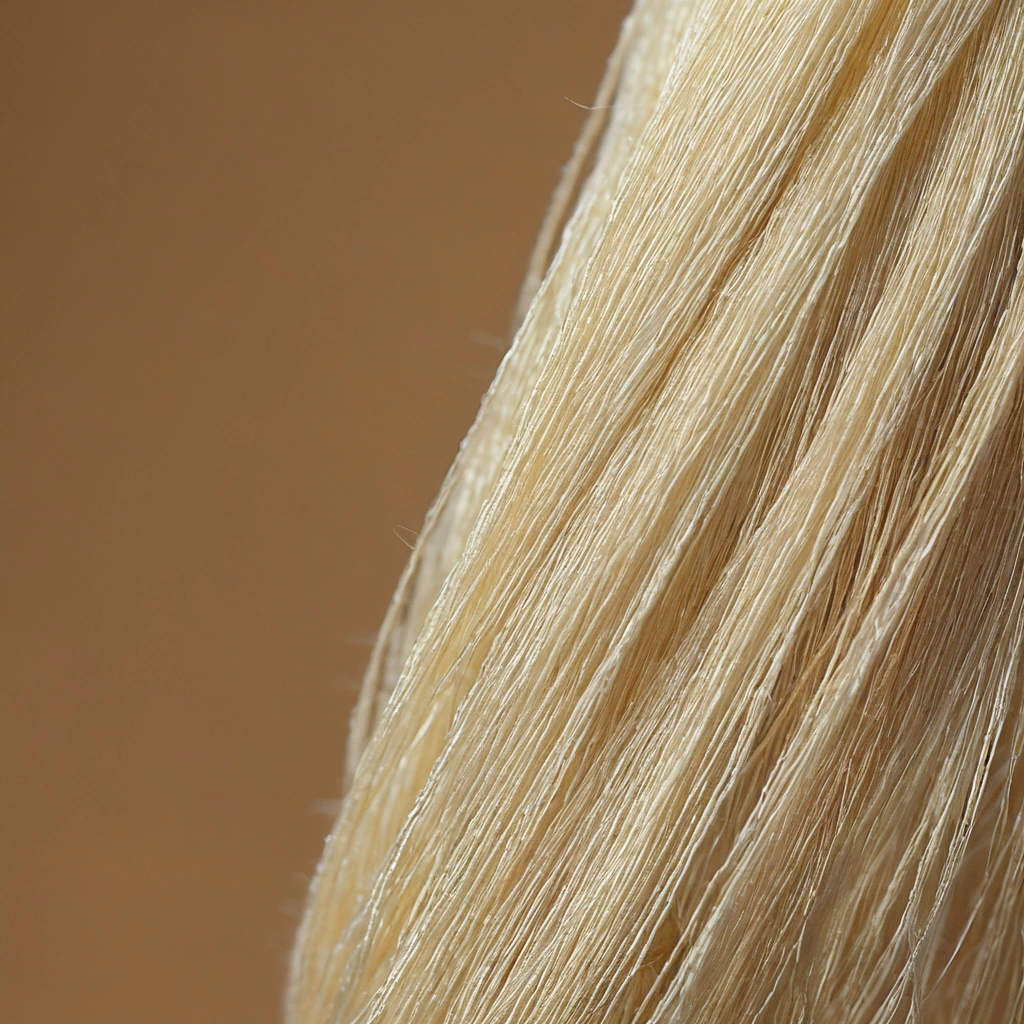
Raw silk cost about $59 per kg on the Chinese spot market in July 2026, per SunSirs data reported by UrSilk, and India’s CIF raw silk price rose about 4 percent per quarter during Q1 2026 according to price-watch.ai’s silk price series.
The two quotations are different instruments and cannot be differenced: a spot price settles for immediate delivery in the Chinese market, while a CIF price carries cost, insurance and freight to an Indian port. The CIF movement gives direction, and 4 percent per quarter compounds to about 17 percent over four quarters.
No source reviewed publishes a finished silk rug price per square metre or a silk furnishing fabric price per linear metre, so the $59 per kg figure cannot be converted into a retail comparison. The fibre price enters a silk-on-silk carpet twice, as pile yarn and as foundation.
What Is Fibroin, and Why Does Silk Take a Finer Knot Than Wool?
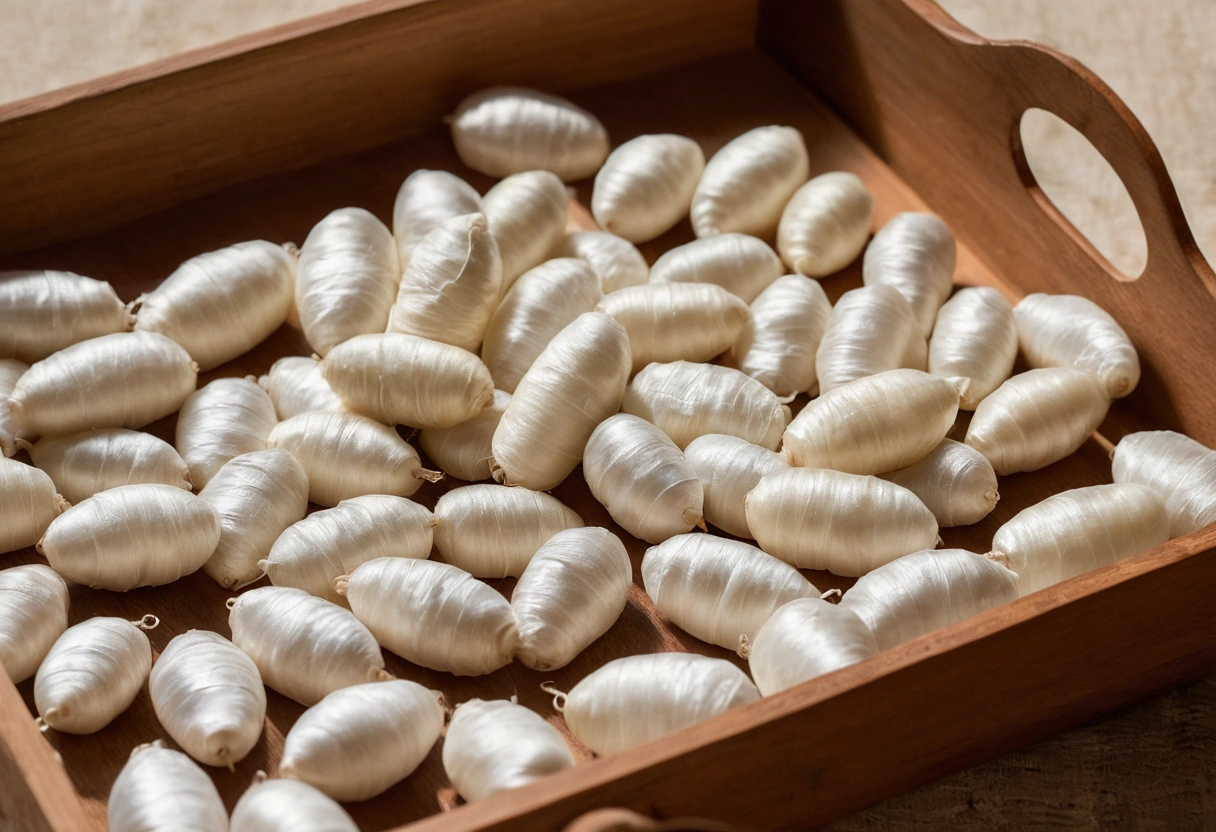
Silk is a protein filament rather than a staple: one cocoon yields a continuous fibroin thread bound by sericin gum. Because a reeled silk yarn has no fibre ends to slip apart, silk can be drawn fine enough to fill a knot grid that a wool yarn of comparable strength cannot.
Fibroin is the structural protein at the centre of the filament, sericin is the gum holding its two brins together, and degumming removes most of the sericin before dyeing. The fibroin cross-section is roughly triangular, so light returns from the facets at an intensity that depends on the angle of incidence, and a silk pile changes tone as the nap direction changes relative to the light source.
Wool is a crimped staple with cuticle scales, which gives a wool yarn loft and recovery. Silk has high tensile strength for its fineness and little recovery from sustained compression, so a silk rug carries its pattern in knot resolution rather than pile height, and slippery filament yarns put the structure on knot tension and a firm silk foundation. The sources reviewed publish no tenacity, elongation or abrasion values for rug silk, so the comparison here is structural.
How Much Raw Silk Does India Produce?
India produced 42,033 tonnes of raw silk in 2025–26, up 2.2 percent, with mulberry silk at 32,250 tonnes and bivoltine silk at 11,229 tonnes, up 10.52 percent, according to Central Silk Board data reported by Fibre2Fashion’s report on India’s raw silk output.
The reported breakdown does not sum to the reported total: 32,250 plus 11,229 tonnes is 43,479 tonnes, or 1,446 tonnes more than the national figure, so the categories as reported are not mutually exclusive. Bivoltine names a silkworm race rather than a separate fibre, and the Central Silk Board’s category definitions are not published in the report reviewed here.
The world crop of about 94,000 tonnes in 2024 is an IndexBox market estimate rather than an official sericultural series. India’s 42,033 tonnes is about 45 percent of that estimate, but the two figures come from different publishers, series types and years, so the share is an order of magnitude rather than a statistic. At the Chinese July 2026 spot quotation, India’s 2025–26 crop is about $2.48 billion of raw fibre.
What Knot Density Do Hereke Silk Rugs Actually Reach?
Hereke silk rugs are advertised at 654 to more than 1,200 knots per square inch, and Morgenland Rugs’ Hereke collection page gives a theoretical maximum of 25 knots per square centimetre alongside 6 million knots per square metre. Every figure comes from a seller, no independent record of a measured Hereke silk density exists, and no source publishes a sample size, a measured area or a test method.
The two maxima quoted by the same seller do not convert into each other. Twenty-five knots per square centimetre is 250,000 knots per square metre, about 161 kpsi; 6 million knots per square metre is 600 knots per square centimetre, about 3,871 kpsi. The two quoted maxima differ by a factor of 24.
Assuming a square knot grid, 1,200 kpsi puts knots about 34.6 per running inch, a pitch of roughly 0.73 mm, 654 kpsi about 1 mm and 3,871 kpsi about 0.41 mm, finer than the knot it has to contain. A knotted grid is rarely square, because warp spacing, weft spacing and knot type differ, so these pitches are derived geometry.
| Claim | Source type | Knots per square cm | Knots per square m | Independent record |
|---|---|---|---|---|
| Hereke silk, 654 kpsi | seller, Morgenland Rugs | about 101 | about 1.01 million | none published |
| Hereke silk, 1,200 kpsi and above | seller, Morgenland Rugs | about 186 | about 1.86 million | none published |
| Maximum, 25 knots per square cm | seller, Morgenland Rugs | 25 as quoted | 250,000 | none published |
| Maximum, 6 million knots per square m | seller, Morgenland Rugs | 600 | 6,000,000 | none published |
| Ardabil carpet average, 340 kpsi | museum record, V&A | about 52.7 | about 527,000 | documented by the V&A |
How Does the Dealer Range Compare With the Ardabil Carpet’s Density?
The Ardabil carpet in the Victoria and Albert Museum averages 340 knots per square inch, and 340 kpsi is the only density figure here documented by an institution that measured the object. The advertised Hereke range starts at about 1.9 times the Ardabil density, runs to about 3.5 times it, and the 6-million-per-square-metre variant implies roughly 11 times it.
A 6×9 ft silk rug covers 7,776 square inches, or 5.02 square metres, and holds about 2.64 million knots at 340 kpsi, 5.09 million at 654 kpsi, 9.33 million at 1,200 kpsi and about 30.1 million at 6 million knots per square metre. Each step multiplies yarn length and knotting time on an identical footprint, and each step rests on a figure nobody outside the seller has measured.
Why Does Silk-on-Silk Construction Command Its Price?
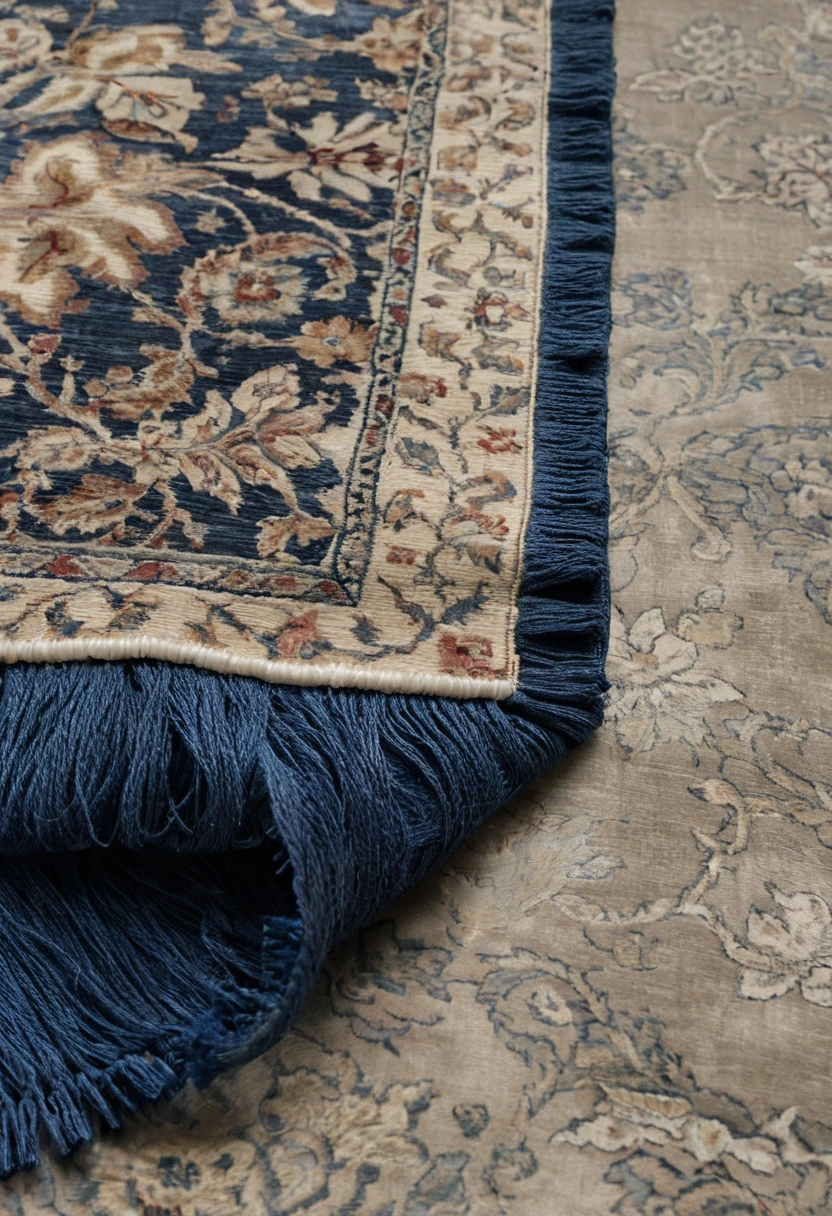
Silk-on-silk means a silk pile knotted onto silk warp and weft, and the price follows from three quantities multiplied together: about $59 per kg for raw silk in July 2026, knot counts in the millions for one rug, and a foundation of silk rather than cotton. A rug sold as silk with a cotton foundation is a different material bill.
The fibre mass in one rug cannot be calculated here, because no publisher in this set lists a pile weight per square metre for silk rugs. The multiplier can be: 340 kpsi to 1,200 kpsi multiplies the knot count by about 3.5 on the same floor area, and every extra knot is a length of yarn and a knotter’s motion.
Resolution is what the density premium buys. At 654 kpsi the knot pitch is about 1 mm, so a motif can only be drawn on a millimetre grid, and a short sheared silk pile keeps that grid legible under raking light. The quoted density also scales the price, and no source reviewed publishes a workshop specification or a test certificate for it.

What Should a Buyer Ask Before Paying a Silk Density Premium?
Five questions convert an advertised density into a checkable number, targeting what the seller literature omits: area, unit, method, fibre split and price basis.
- Ask where the count was taken and over what area, since density in the field differs from density at the borders, and whether the figure is an average or a minimum.
- Ask for the unit and its conversion: one square inch equals 6.4516 square cm, one square metre about 1,550 square inches, and 654 kpsi about 1.01 million knots per square metre.
- Ask whether pile and foundation are both silk, because silk-on-silk and silk pile on a cotton foundation carry different material bills.
- Ask whether the density is a workshop specification for the model or a measurement of the individual rug being sold, and who measured it.
- Ask which fibre and which price basis the quote assumes, since a Chinese spot price and an Indian CIF series describe different markets.
A supplier who answers all five questions lets a buyer reproduce the density and the fibre cost independently. A supplier who answers none is quoting a band, and one seller’s own figures span 654 to 3,871 kpsi, a factor of nearly six.
What Do the Silk Terms Mean?
Five terms carry the arithmetic in this article.
- Fibroin
- The structural protein filament of a cocoon, with a roughly triangular cross-section that returns light at an angle-dependent intensity.
- Sericin
- The gum binding the two brins of one cocoon filament, most of which degumming removes before dyeing.
- Bivoltine silk
- Silk from bivoltine silkworm races, the category reeling mills specify for a fine even filament; India reported 11,229 tonnes in 2025–26.
- kpsi
- Knots per square inch, read on the reverse over a stated area; 654 kpsi is about 101 knots per square cm.
- Silk-on-silk
- A hand-knotted rug with a silk pile tied onto silk warp and weft, as distinct from silk pile on a cotton foundation.
Raw silk at about $59 per kg in July 2026 and India’s 42,033 tonnes in 2025–26 have named publishers and periods. Silk rug knot density has neither: 654 kpsi, 1,200 kpsi, 25 knots per square cm and 6 million knots per square metre all trace to sellers, and the Ardabil carpet’s documented 340 kpsi is the only density here that an institution measured.