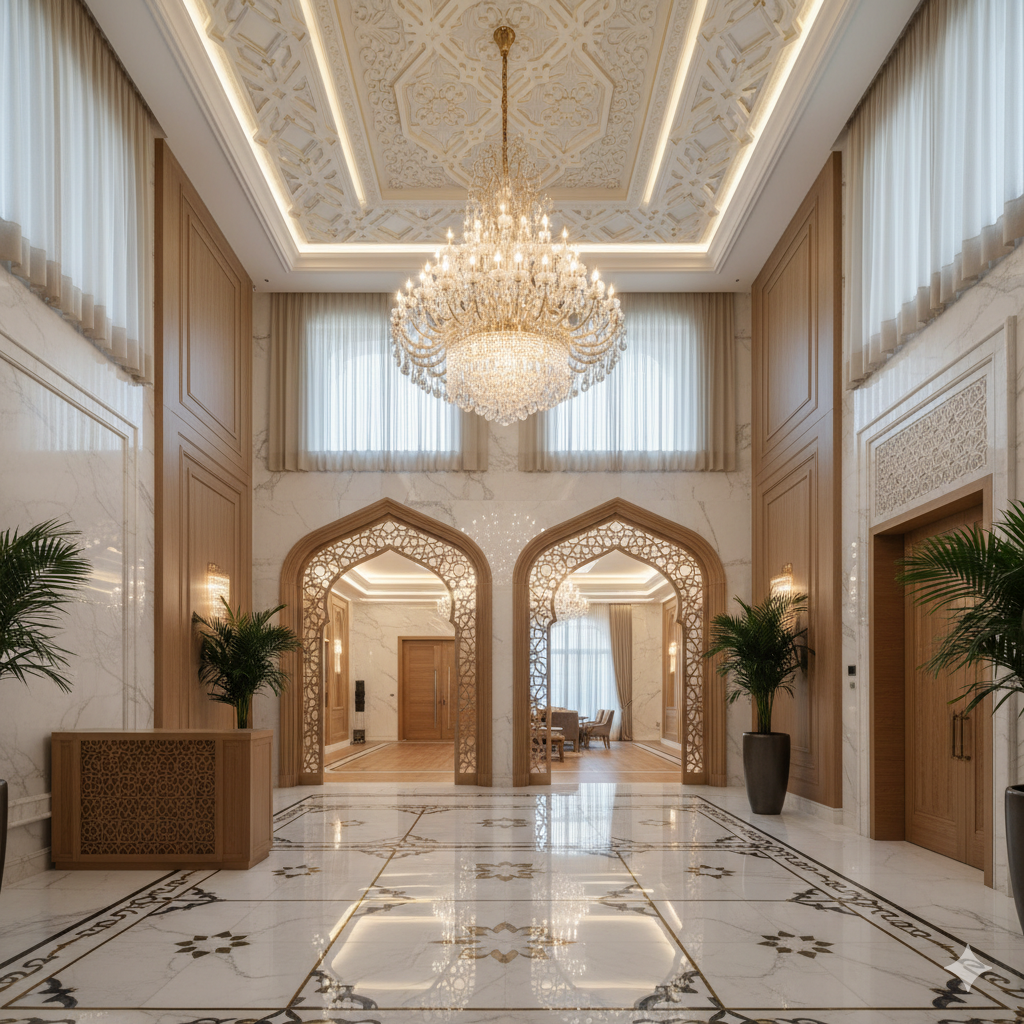
Choosing the wrong hard flooring for a Gulf villa leaves residents with uneven surface temperatures, scratched entryways, or recurring maintenance bills that compound over decades. Procurement teams comparing materials for Middle Eastern residences often default to travertine for its heritage appeal, overlooking how mechanical cooling systems interact with slab physics. A polished Roman travertine floor left in direct afternoon sun absorbs and retains heat differently than a large-format pressed porcelain slab of comparable thickness. The material that wins the barefoot test on a shaded terrace loses inside a mechanically cooled majlis running hydronic pipes at low supply temperatures. Selecting a single slab for every zone guarantees compromised comfort or drives up chiller energy consumption to compensate for poor thermal transfer. See also: Gulf entertaining spaces.
Contents
- Does travertine or porcelain stay cooler on UAE villa floors?
- Is travertine more expensive than porcelain tile in the UAE?
- What PEI rating does UAE villa flooring need against desert sand?
- How do you install large-format porcelain slabs compared to travertine in the Gulf?
- What maintenance does travertine require that porcelain does not in a humid climate?
- Key takeaways: Which flooring suits your UAE villa project?
Key takeaways
- Travertine generally feels cooler underfoot in unconditioned UAE spaces because its lower thermal conductivity slows heat transfer from direct sunlight.
- Installed travertine typically costs significantly more than large-format porcelain in UAE villas.
- Fine quartz desert sand acts as a constant abrasive in UAE homes, making wear resistance critical.
- Installing large-format porcelain slabs, typically 120x240cm or larger, in UAE villas requires perfectly level screeds, specialized suction lifters, and polymer-modified thin-set adhesives designed for low-porosity surfaces.
- Travertine is a porous calcium carbonate stone that requires initial impregnating sealers and periodic reapplication to resist staining from spills and moisture penetration, particularly in UAE coastal villas where humidity accelerates degradation.
Does travertine or porcelain stay cooler on UAE villa floors?
Travertine generally feels cooler underfoot in unconditioned UAE spaces because its lower thermal conductivity slows heat transfer from direct sunlight. In air-conditioned villas with radiant floor cooling, porcelain slabs respond faster because of their higher density and uniform thickness, distributing chilled water temperatures more evenly across living areas.
How a surface feels underfoot changes dramatically between shaded terraces and indoor living areas. On a shaded outdoor terrace where solar radiation is blocked but ambient air remains hot, travertine stays closer to the surrounding air temperature because its porous structure resists rapid heat exchange. Porcelain in the same shaded area may initially feel slightly cooler to the touch due to its higher effusivity, but it also absorbs ambient heat more readily once the shade moves. Inside a villa maintaining standard residential cooling setpoints, the pattern reverses. The air conditioning system lowers the room temperature, and both slabs eventually reach equilibrium. The denser porcelain reaches that equilibrium faster, providing a consistently cool surface across the entire floor plan. Travertine, with its insulating voids, takes longer to shed stored heat, leaving localized warm spots near exterior glazing or above structural elements where cooling airflow stagnates.
Villa owners must match the material to each room’s thermal environment. Shaded loggias and covered pool decks benefit from the slower heat transfer of natural stone. Interior corridors and living rooms relying on forced-air cooling perform better with dense porcelain that stabilizes quickly. Specifying a single flooring material throughout the residence ignores these distinct thermal zones.
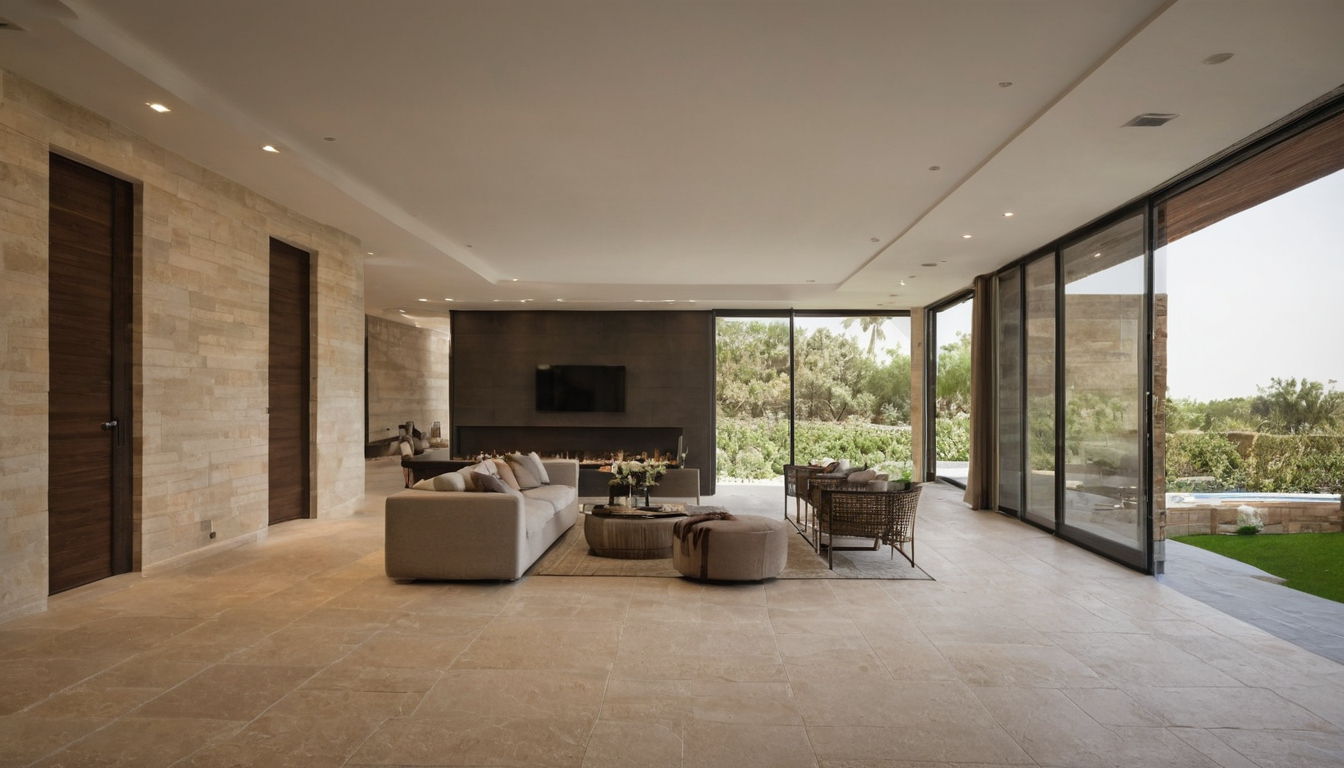
Does travertine or porcelain stay cooler on UAE villa floors.
Manufacturers of radiant cooling systems set maximum thermal resistance limits for floor coverings to ensure the chiller operates within its designed capacity. Exceeding those limits forces the mechanical plant to run longer cycles, increasing energy consumption and raising the risk of condensation forming on the slab surface if the floor temperature drops below the dew point of the humid indoor air. Porcelain slabs, typically available in uniform thicknesses suited for large-format installations, fit predictably within these engineering limits. Travertine requires careful selection of block density and precise adjustment of mortar bed thickness to keep the assembly within acceptable resistance thresholds.
Installation also introduces variables that affect indoor air quality during commissioning. The U.S. Environmental Protection Agency identifies paints, varnishes, waxes, cleaning products, building materials, and furnishings as common indoor sources of volatile organic compounds (U.S. Environmental Protection Agency). Setting either travertine or porcelain over a radiant cooling substrate involves adhesives, primers, grouts, and sealants that off-gas during curing. The U.S. Environmental Protection Agency recommends increasing ventilation when using products that emit volatile organic compounds indoors (U.S. Environmental Protection Agency). Because travertine requires sealing compounds and thicker adhesive beds to accommodate its irregular underside, the volume of applied chemical products often exceeds what a porcelain installation requires. This extends the period during which active mechanical ventilation is necessary before the villa can be safely occupied.
Porcelain delivers predictable thermal transfer for engineered cooling systems, while travertine requires adjustments for its natural irregularities. Predictable performance reduces long-term mechanical strain, but the purchasing decision cannot rest on thermal physics alone. The total installed cost determines whether porcelain’s superior radiant response justifies the budget.
Is travertine more expensive than porcelain tile in the UAE?
Installed travertine typically costs significantly more than large-format porcelain in UAE villas. Material prices for premium Roman travertine start higher, but the real cost difference emerges during installation: natural stone requires thicker mortar beds, precise sealing, and skilled stonemasons, while rectified porcelain uses thinner adhesive layers and faster setting methods.
Villa owners who select travertine based solely on slab pricing often face a budget shock when contractors submit final installation quotes. The visible stone is only one part of the total expense. A useful decision checklist separates supply from labor, consumables, and long-term upkeep to show where the money actually goes.
- Material supply: Premium travertine slabs cost more per square meter than comparable large-format porcelain. Quarry origin, block selection, and vein matching drive natural stone premiums that factory-produced porcelain avoids through standardized manufacturing runs.
- Mortar bed thickness: Travertine requires a thicker mortar bed to accommodate natural dimensional variations between individual slabs. Porcelain slabs are rectified to tight tolerances, allowing thin-set adhesive methods that use less material and reduce floor buildup height.
- Labor skill requirements: Laying natural stone requires experienced stonemasons who can book-match veins, manage lippage across variable slab thicknesses, and cut dense rock without chipping edges. Porcelain installation relies on specialized suction lifters and leveling systems, but the overall labor hours per square meter remain lower.
Assuming that natural stone automatically justifies its premium in luxury interiors ignores how these installation variables compound. Across a large villa ground floor, every per-meter labor hour and consumable requirement adds up to a substantial difference in total cost. Procurement teams evaluating hard flooring must calculate the fully installed figure rather than compare showroom slab prices alone.
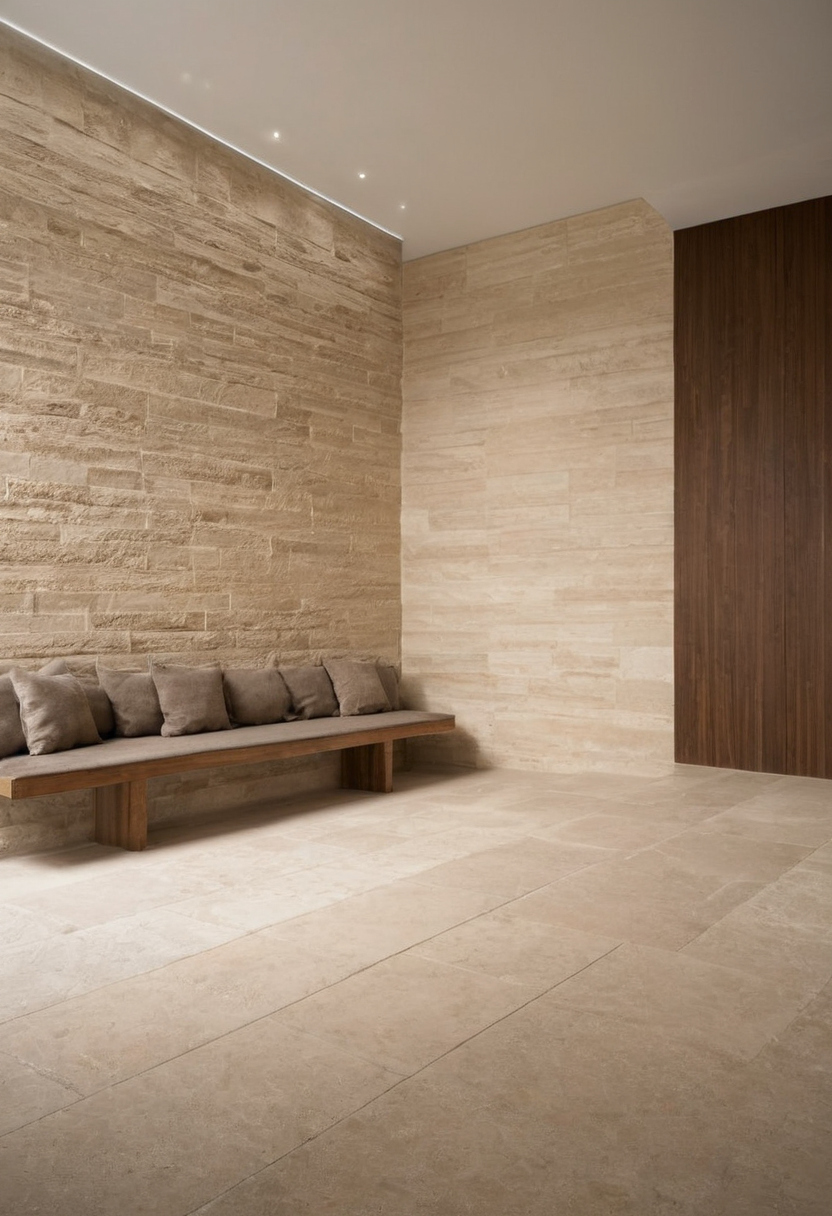
Is travertine more expensive than porcelain tile in the UAE.
Spending more on the initial floor does not guarantee better resistance to the abrasive environment outside the villa doors. Fine quartz particles carried into living spaces test any flooring investment regardless of the purchase price.
What PEI rating does UAE villa flooring need against desert sand?
Fine quartz desert sand acts as a constant abrasive in UAE homes, making wear resistance critical. Porcelain slabs rated PEI IV or V withstand this friction indefinitely without visible scratching. Travertine, a softer calcite-based limestone, will develop a patina and micro-scratches over time unless regularly honed and sealed in high-traffic villa zones.
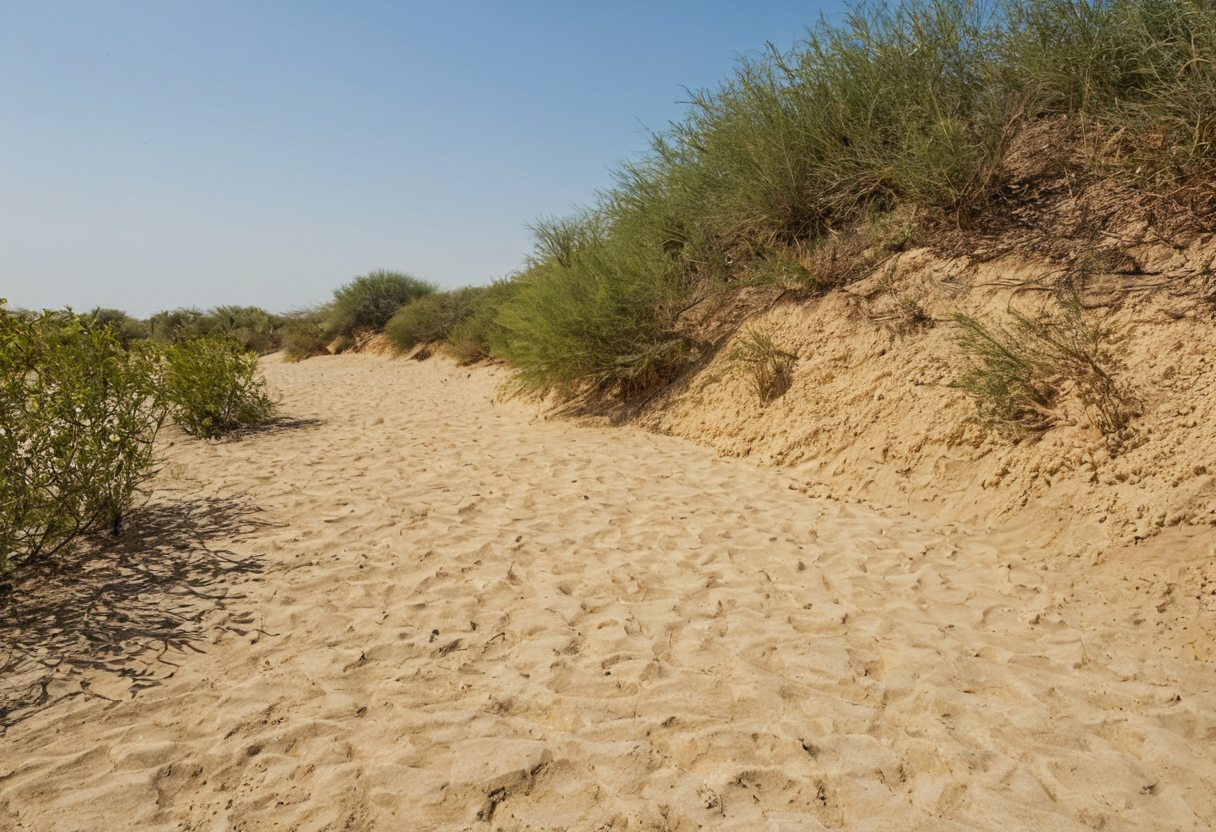
The obvious assumption in luxury Gulf construction is that natural stone endures because it has survived centuries in regional architecture. That logic ignores what destroys modern polished floors: windblown silica tracked indoors on shoes. A villa entrance in Dubai or Abu Dhabi receives fine sand daily. That sand does not compress underfoot. It grinds. Specifying a floor covering without calculating its hardness relative to that grit guarantees premature surface failure, regardless of the material cost.
Porcelain abrasion resistance follows the ISO 10545-7 standard, which classifies glazed tiles into PEI ratings from 0 to V based on the number of abrasive revolutions required to produce visible wear. Unglazed through-body porcelain slabs have no glaze, offering uniform hardness throughout their thickness. For interior villa zones exposed to outdoor footwear, specifying anything below PEI IV invites visible wear within the first few years of occupancy. PEI V remains the safer threshold for main corridors, majlis areas, and entry halls where sand accumulation peaks.
Travertine lacks a comparable standardized abrasion scale because its composition varies by quarry block. Calcite registers at Mohs 3. Quartz sand, the dominant mineral in Arabian deserts, sits at Mohs 7. The difference is stark: the tracked-in grit is more than twice as hard as the stone beneath it. Every footfall drags microscopic silica crystals across a softer calcium carbonate matrix. Polished travertine shows these scratches immediately because the reflective finish amplifies light scattering from every micro-groove. Honed finishes mask early damage better, but material is still being removed.
Glazed porcelain resists this plowing action through extreme firing temperatures that fuse the surface into a glass-like matrix. High-quality large-format porcelain slabs reach surface hardness levels approaching Mohs 7 or higher, effectively matching the abrasive itself. When quartz sand slides across a PEI IV or V glazed surface, the grit fails to penetrate. The sand moves; the glaze holds. Matte porcelain finishes further reduce the visual impact of any superficial scuffing because they lack the mirror reflection that highlights defects.
Cleaning methods widen this difference in vulnerability. Scrubbing embedded dirt from scratched travertine often worsens the damage. The Natural Stone Institute warns that scouring powders or creams can scratch natural stone surfaces because those products contain abrasives. Applying an abrasive cleaner to stone already damaged by quartz sand accelerates the very wear the homeowner is trying to prevent. Porcelain tolerates standard neutral cleaning agents without structural damage, removing the risk of maintenance-induced wear.
Textured porcelain designed for exterior use achieves high slip resistance ratings under standards such as DIN 51130, typically reaching R11 or R12 classifications suitable for wet pool decks. Manufacturers form these textures in the body before firing, so the grip pattern cannot wear away under foot traffic. UV exposure does not fade fired ceramic pigments. A textured porcelain terrace installed in Riyadh or Dubai retains its color stability and surface profile indefinitely against direct equatorial sunlight.
Honed travertine offers a cooler surface temperature under direct sun due to its lighter color palette and natural thermal mass, a genuine comfort advantage for bare feet. However, honed stone outdoors requires rigorous sealing against moisture penetration and chemical staining from pool treatments. Unsealed travertine absorbs chlorinated water, leading to efflorescence and surface spalling over repeated wet-dry cycles. The visual warmth of natural stone on a terrace comes with recurring maintenance that textured porcelain eliminates entirely.
The choice between these materials for exterior zones depends on whether the project prioritizes tactile tradition or zero-maintenance performance. For high-traffic Gulf entertaining spaces extending from indoor majlis areas to outdoor terraces, maintaining a continuous visual flow while meeting different technical requirements often means selecting a porcelain slab collection that mimics the look of stone outdoors while delivering the necessary slip resistance.
Understanding how sand destroys polished stone explains why material selection matters. But even the heaviest engineered slab fails if substrate preparation ignores the physical realities of Gulf construction.
What PEI rating does UAE villa flooring need against desert sand.
How do you install large-format porcelain slabs compared to travertine in the Gulf?
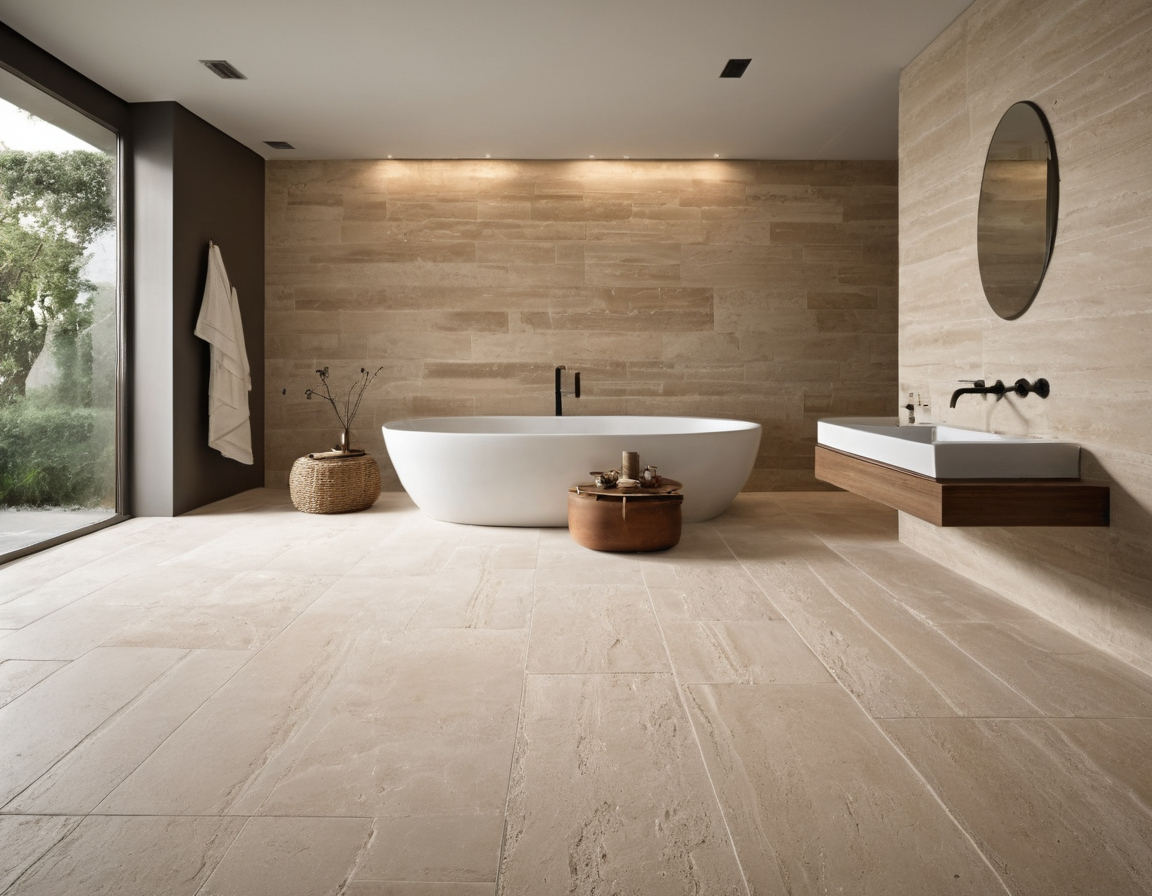
Installing large-format porcelain slabs, typically 120x240cm or larger, in UAE villas requires perfectly level screeds, specialized suction lifters, and polymer-modified thin-set adhesives designed for low-porosity surfaces. Travertine installation relies on traditional thick-bed methods, back-buttering to fill natural voids, and immediate sealing to prevent alkali efflorescence from cementitious adhesives.
Porcelain installation depends on substrate flatness tolerances. Large-format slabs require a maximum deviation of roughly 3mm over a 3-meter straight edge. A standard sand-cement screed rarely meets this specification without grinding or a self-leveling compound applied beforehand. Travertine tolerates greater substrate variation because the installer adjusts mortar bed thickness beneath each tile during placement. As a result, porcelain projects carry higher preparation costs before a single slab leaves its crate.
Adhesive selection separates reliable floors from failed ones. Porcelain absorbs almost no water, so standard cement adhesives lack mechanical grip. Installers must use deformable, polymer-modified adhesives rated C2TE S1 or S2 under EN 12004 standards. The S1 or S2 classification ensures the adhesive flexes under thermal stress rather than debonding when Gulf temperature swings expand and contract the concrete subfloor. Full coverage is equally important: installers apply adhesive to both the substrate and the slab back using a notched trowel to eliminate hollow spots that invite cracking under point loads.
Travertine presents a different bonding challenge. Natural stone varies in density and often contains open voids on the underside. Back-buttering every piece with adhesive fills these cavities and prevents air pockets. Unfilled travertine requires additional grout work during installation to close surface holes, adding labor time that porcelain avoids entirely. Cementitious adhesives can also trigger alkali efflorescence, pushing white mineral salts through porous stone if the installer skips applying a penetrating sealer before laying begins.
How do you install large-format porcelain slabs compared to travertine in the Gulf.
Expansion joints accommodate the extreme thermal cycling found across Emirates climates. Both materials need perimeter gaps and intermediate movement joints spaced according to slab dimensions and expected temperature ranges. Porcelain systems generally follow manufacturer spacing grids tied to panel size, while stone layouts depend on site-specific engineering assessments. Ignoring joint placement guarantees tenting or cracking once summer heat penetrates ground-floor slabs.
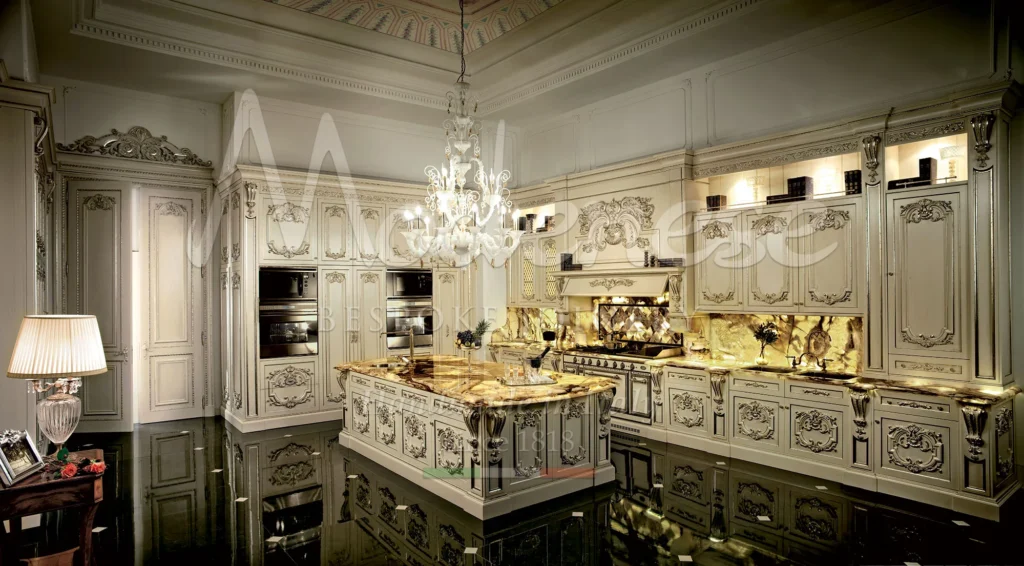
Flooring specifications must also account for heavy custom joinery. When planning bespoke Italian kitchen design, the installation sequence must account for island weight resting on finished floor panels. Porcelain slabs tolerate concentrated loads well if fully supported by adhesive, while unfilled travertine risks fracture beneath heavy cabinetry points unless reinforced.
The installation method determines how much ongoing effort the floor demands. Once the adhesive cures and the grout sets, the material itself dictates the cleaning schedule.
What maintenance does travertine require that porcelain does not in a humid climate?
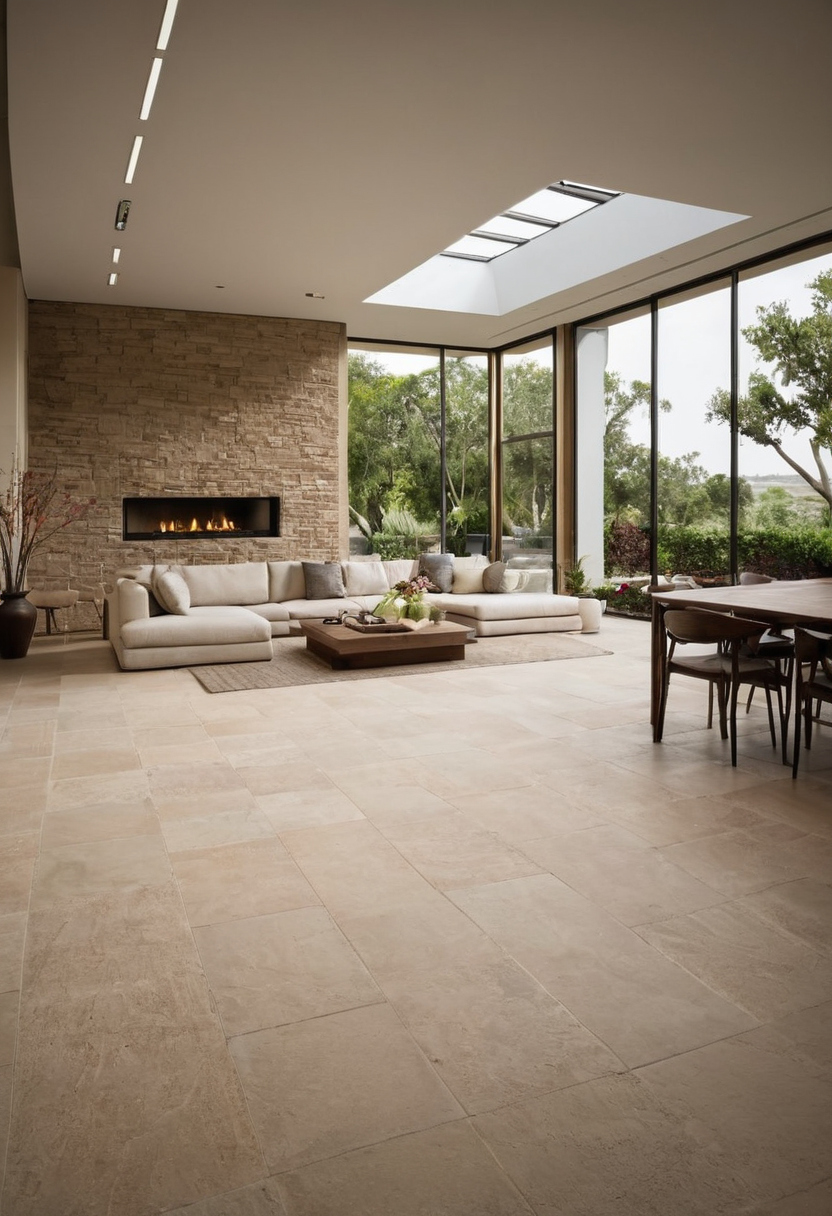
Travertine is a porous calcium carbonate stone that requires initial impregnating sealers and periodic reapplication to resist staining from spills and moisture penetration, particularly in UAE coastal villas where humidity accelerates degradation. Porcelain slabs are virtually non-porous and need only routine cleaning without chemical sealants, making them substantially cheaper to maintain over decades.
Water absorption defines the maintenance gap between these two materials. Travertine typically absorbs water at rates far exceeding the strict limits applied to porcelain under ISO 10545-3 testing, which classifies porcelain as having less than 0.5 percent absorption. That porosity allows spilled liquids, fine sand, and ambient moisture to penetrate unsealed travertine surfaces. Coastal Emirates such as Dubai and Abu Dhabi experience sustained high relative humidity, forcing moisture into micro-fissures and open pores of natural stone floors. Without an active barrier, dissolved minerals leave permanent etch marks and discoloration across villa interiors.
Penetrating impregnating sealers provide the primary defense for travertine flooring in Gulf residences. These treatments fill the pore structure without changing the stone’s appearance, repelling water and oil-based stains before they bond with the calcium carbonate matrix. Topical sealers create a surface film but trap moisture underneath, leading to hazing in humid environments. Property owners must plan for regular reapplication of penetrating sealers to maintain protection, adding recurring labor that glazed or unglazed porcelain entirely avoids. Porcelain requires no chemical barrier because its vitrified body inherently resists liquid penetration.
Routine cleaning further separates the long-term costs of these surfaces. The Natural Stone Institute recommends cleaning natural stone surfaces with neutral cleaners, stone soap, or mild liquid dishwashing detergent and warm water. Acidic household substances like citrus juice or vinegar etch polished travertine instantly, stripping the finish and leaving dull spots. Glazed porcelain tolerates standard residential cleaning agents without chemical damage, removing the need for specialized pH-neutral products.
What maintenance does travertine require that porcelain does not in a humid climate.
Moisture trapped beneath or within porous stone creates risks beyond surface staining. The U.S. Environmental Protection Agency states that condensation and wet or damp spots should be fixed promptly to prevent mold growth (U.S. Environmental Protection Agency). In ground-floor villa rooms where sub-slab moisture migrates upward, unsealed travertine can hold dampness longer than dense porcelain, requiring vigilant climate control and faster spill response from residents.
Maintenance planning determines whether a specified floor keeps its appearance or degrades under Gulf conditions. Knowing what each material demands over time clarifies the final choice.
Key takeaways: Which flooring suits your UAE villa project?
Porcelain slabs offer superior abrasion resistance against desert sand, lower lifetime maintenance costs, and better compatibility with modern radiant cooling systems in UAE villas. Travertine provides natural aesthetic variation and cooler barefoot surface temperatures in unconditioned spaces, justifying its higher installed cost and ongoing sealing requirements for owners who prioritize authentic luxury.
Assuming that natural stone automatically elevates a Gulf residence ignores the physics of fine quartz sand and coastal humidity. Specifying travertine across every room because it signals prestige often produces scratched surfaces in entryways and moisture problems near pools. Porcelain does not carry the same geological romance, yet it survives daily life in a Dubai or Abu Dhabi home with far less intervention.
A practical specification strategy assigns each material to the zone where its properties solve the main problem. The following matrix pairs common villa areas with the flooring choice that performs best under local conditions.
Selecting flooring for a Middle Eastern villa requires separating emotional preference from environmental performance. Owners who match materials to specific zones rather than defaulting to a single surface throughout the house protect both their investment and the architectural intent. Start by reviewing the traffic patterns, moisture exposure, and cooling systems in each room before finalizing the stone or slab order.
Key takeaways: Which flooring suits your UAE villa project.
For more on this topic, see other guides on this site.